exposing the origins of antisemitism


THE HOLOCAUST, 1933–1945: HOW CENTURIES OF LIES BECAME GENOCIDE
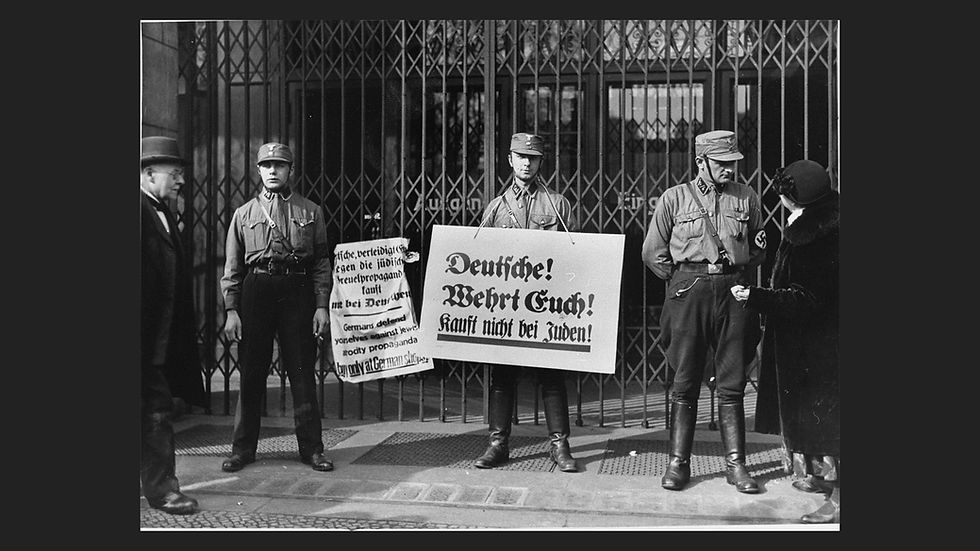
SA men picket a Jewish-owned shop in Berlin during the Nazi boycott of April 1, 1933. Their signs are Nazi propaganda urging Germans not to buy from Jews. United States Holocaust Memorial Museum, courtesy of National Archives and Records Administration, College Park.
The Holocaust was the state-sponsored murder of six million European Jews by Nazi Germany and its allies and collaborators, prepared by propaganda and laws and built on lies about Jews that were centuries old.
First published: October 5, 2026
Key Facts
-
What it was: The systematic, state-sponsored persecution and murder of six million European Jews by Nazi Germany and its allies and collaborators, from 1933 to 1945.
-
Its roots: Centuries of religious and racial lies about Jews, from the blood libel to the Protocols of the Elders of Zion. None of them was true.
-
How it began: With a boycott and anti-Jewish laws in 1933, the Nuremberg Race Laws in 1935 and the Kristallnacht pogrom in 1938.
-
How it was carried out: In more than 1,300 ghettos, in mass shootings after Germany invaded the Soviet Union in June 1941, and in five killing centers in German-occupied Poland.
-
How we know: The perpetrators' own records, postwar trials, the reports of liberating armies, the sites themselves and large archives of survivor testimony.
-
Modern form: The myths behind it still circulate. Some recent versions of the Protocols even deny that the Holocaust happened.
The Holocaust was, in the words of the United States Holocaust Memorial Museum (USHMM), "the systematic, state-sponsored persecution and murder of six million European Jews by the Nazi German regime and its allies and collaborators." USHMM dates it from 1933 to 1945.
The Nazis did not invent the hatred behind it. Many of the lies they spread about Jews had circulated for centuries, and several are explained on our trope pages. All of them are false.
What was new was a modern state that turned those lies into propaganda, then into law, and finally into mass murder. This article is an overview, not a complete history. Knowing how it happened helps us recognize the same lies when they appear again.
What the Holocaust Was
The Holocaust is also called "the Shoah," the Hebrew word for "catastrophe," USHMM notes. It began in January 1933, when Adolf Hitler and the Nazi Party came to power in Germany. It ended in May 1945, when the Allies defeated Nazi Germany. Yad Vashem, the World Holocaust Remembrance Center in Jerusalem, describes it as "unprecedented genocide, total and systematic, perpetrated by Nazi Germany and its collaborators, with the aim of annihilating the Jewish people."
In 1933, Europe's Jewish population "numbered 9 million people," according to USHMM. During World War II, Nazi Germany and its allies and collaborators killed "nearly two out of every three European Jews." USHMM states the toll as six million. Yad Vashem notes that there is "no precise figure," but that "All the serious research confirms that the number of victims was between five and six million." USHMM explains that the figure is calculated from Nazi German documents and from prewar and postwar population data. It breaks the toll down by where and how the victims were killed:
-
Killing centers: Approximately 2.7 million Jews were murdered at the five killing centers.
-
Mass shootings: About 2 million were murdered in mass shooting operations and related massacres.
-
Ghettos and camps: Between 800,000 and 1,000,000 were murdered in ghettos, labor camps and concentration camps.
-
Other violence: At least 250,000 were murdered in other acts of violence outside camps and ghettos.
The Nazis and their allies and collaborators also murdered millions of non-Jewish people. USHMM gives these estimates by group. They are counted separately from the six million Jews and are never added to that figure:
-
Soviet prisoners of war: around 3.3 million.
-
Non-Jewish (ethnic) Poles: around 1.8 million.
-
Roma: at least 250,000, but possibly as high as 500,000 Romani men, women and children and other people derogatorily labeled as "Gypsies."
-
Serb civilians: more than 310,000, murdered by the Ustaša authorities of the Independent State of Croatia.
-
People with disabilities: 250,000–300,000 living in institutions and care facilities, including at least 10,000 children.
-
Political opponents: tens of thousands of German political opponents and dissenters.
-
"Professional criminals" and "asocials": tens of thousands of Germans imprisoned in concentration camps under these labels.
-
Jehovah's Witnesses: about 1,700 killed in concentration camps or executed for refusing to serve in the German military.
-
Gay and bisexual men: hundreds, possibly thousands of men accused of homosexuality.
-
Black people in Germany: unknown, perhaps hundreds.
Roots: From Religious Hatred to Racial Antisemitism
For centuries, according to USHMM, the Church taught that Jews were responsible for the death of Jesus. This charge of deicide cast Jews as enemies of Christianity. Most historians today recognize, as USHMM notes, that Jesus was executed by the Roman government.
The charge fed new myths in the Middle Ages. The blood libel falsely claimed that Jews murdered Christian children for ritual purposes. The well-poisoning myth falsely blamed Jews for the Black Death. Both lies led to violence against Jewish communities.
In the 19th century, the hatred took a new form. Racial antisemitism is, in USHMM's words, "the discriminatory idea that Jews are a separate and inferior race." Under this idea, a Jew who converted to Christianity was still counted as a Jew. The word "antisemitism" itself was coined in German in the late 1800s, USHMM notes. The German journalist Wilhelm Marr helped popularize it. His 1879 book, The Victory of Jewry over Germandom, ran through twelve editions in its first year, according to German History in Documents and Images.
The old myths were then repackaged for a mass audience:
-
The Protocols, 1903: The Protocols of the Elders of Zion, a forgery first published in the Russian Empire, claimed a secret Jewish plan to rule the world. In 1923, the leading Nazi thinker Alfred Rosenberg published a commentary on it. By 1938, according to USHMM, the Nazi Party's publishing house had issued 22 printings.
-
The caricature: Newspapers in Germany, above all Der Stürmer (The Attacker), printed cartoons built on the hook-nosed caricature of Jews, USHMM notes. It is an invented image, not a picture of real people.
-
The blood libel revived: Der Stürmer "frequently employed the blood libel motif," USHMM reports, and its May 1934 volume "was devoted specifically to the blood libel."
-
Money and power: Nazi propaganda also drew on "older negative stereotypes," USHMM explains, "including Jews as communist subversives, as war profiteers and hoarders." The money myth is traced on our Coin Clipping page.
None of these claims was true. As USHMM puts it, "Antisemitism was at the foundation of the Holocaust."
1933–1939: Persecution by Law
Persecution began as soon as the Nazis took power. President Paul von Hindenburg appointed Hitler chancellor of Germany on January 30, 1933. In March 1933, the SS opened the Dachau concentration camp outside Munich, at first for political opponents of the regime. (Published dates for the opening range from March 20 to March 23.) Hitler also created a Reich Ministry of Public Enlightenment and Propaganda, headed by Joseph Goebbels, to carry the Nazi message through the press, radio, film and schools.
The first anti-Jewish measures followed within weeks, according to USHMM:
-
Boycott, April 1, 1933: Nazi SA men stood outside Jewish-owned shops and businesses across Germany with signs telling Germans not to buy from Jews.
-
Civil service, April 7, 1933: The Law for the Restoration of the Professional Civil Service excluded Jewish and "politically unreliable" employees from state service. It was the regime's first "Aryan Paragraph."
-
The press, October 4, 1933: The Editors Law excluded Jews, and people married to Jews, from journalism. While its propaganda claimed that Jews controlled the press, the regime took control of it. When Hitler took power, the Nazis controlled less than three percent of Germany's 4,700 newspapers; in the end, no more than 1,100 remained, USHMM notes. The story is told on our Media Control page.
-
Nuremberg Race Laws, September 15, 1935: The Reich Citizenship Law and the Law for the Protection of German Blood and German Honor declared that Jews could not be citizens and restricted whom they could marry. A person with three or four Jewish grandparents was defined as a Jew.
Propaganda prepared each step. USHMM notes that propaganda campaigns "created an atmosphere tolerant of violence against Jews, particularly in 1935 (before the Nuremberg Race Laws of September) and in 1938."
USHMM describes a pattern that ran through these years and beyond: legal discrimination, public identification and exclusion, organized violence, and "widespread theft and plunder" of Jewish property. In March 1938, Germany incorporated Austria in the Anschluss, and Austria's Jews came under Nazi rule.
Kristallnacht and the Move to Open Violence
On November 9–10, 1938, the regime turned to open violence. Kristallnacht, often called the "Night of Broken Glass," was a nationwide pogrom across Germany, which by then included Austria and the Sudetenland region of Czechoslovakia.
The pretext was a shooting in Paris. On November 7, a young Jewish man whose family had just been deported from Germany shot a German diplomat. The Nazi press blamed all Jews, and the regime claimed that the gunman "was part of a world Jewish conspiracy," USHMM notes. It was the myth of the Protocols, now used to justify a pogrom.
USHMM and Yad Vashem describe its scale:
-
Synagogues: Nazis burned more than 1,400 synagogues.
-
Businesses and homes: Rioters vandalized thousands of Jewish-owned businesses and broke into Jewish homes.
-
Arrests: Between about 26,000 and 30,000 Jewish men were arrested simply because they were Jewish. Most were sent to the Dachau, Buchenwald and Sachsenhausen concentration camps.
-
Deaths: At least 91 Jews were killed during the pogrom itself, and hundreds died during Kristallnacht and its aftermath.
Afterward, the regime ordered the Jewish community to pay a 1 billion Reichsmark "atonement payment" and rapidly enacted new anti-Jewish laws.
Many Jews tried to leave, but few countries would take them. At a refugee conference in Evian, France, in July 1938, only the Dominican Republic, out of 32 countries invited, offered Jewish refugees any hope, according to Yad Vashem. On May 13, 1939, the ship St. Louis sailed from Hamburg with Jewish refugees. Cuba canceled their landing permits, and the United States did not allow them to land. The ship returned to Europe, and 254 of its passengers were later killed in the Holocaust, USHMM reports.
War and the "Final Solution," 1939–1945
World War II in Europe began when Germany invaded Poland on September 1, 1939. On October 8, German officials set up what was likely the first Nazi ghetto, in Piotrków Trybunalski. In all, the Nazis and their allies established more than 1,300 ghettos, according to USHMM. German authorities deliberately created overcrowded and unsanitary conditions there, and hundreds of thousands of Jews died. Nazi propaganda then blamed the victims. A 1941 Polish-language poster put up in German-occupied Poland read, roughly, "Jews are lice; they cause typhus." According to USHMM, it was the German invasion and the ghettos, with their hunger, overcrowding and unsanitary conditions, that created the typhus epidemics.
Germany invaded the Soviet Union on June 22, 1941. Behind the front, the Einsatzgruppen (so-called mobile killing units) and other German forces, often helped by local auxiliaries, carried out mass shootings in more than 1,500 cities, towns and villages. Some massacres also used gas vans. At Babyn Yar, outside Kyiv, about 34,000 Jews were shot on September 29–30, 1941.
USHMM describes the "Final Solution" as "the deliberate and systematic mass murder of European Jews." The term was a Nazi euphemism. Yad Vashem calls it "a code word for the extermination policy." Hitler authorized the plan "at some still undetermined time in 1941," according to USHMM. Its key steps included:
-
Chełmno, December 8, 1941: The first killing operations began at Chełmno in occupied Poland.
-
Wannsee, January 20, 1942: Fifteen high-ranking Nazi Party and German government officials met at a villa near Berlin to coordinate the "Final Solution" across ministries. Reinhard Heydrich counted about 11 million Jews in Europe, including in countries Germany did not control.
-
Warsaw, July 22–September 21, 1942: Germans deported about 265,000 Jews from Warsaw to the Treblinka killing center.
-
Hungary, from May 15, 1944: The mass deportation of about 430,000 to 440,000 Jews from Hungary began, most of them to Auschwitz-Birkenau.
Nazi Germany operated five killing centers: Chełmno, Belzec, Sobibor, Treblinka and Auschwitz-Birkenau. Approximately 2.7 million Jewish men, women and children were murdered in them, USHMM reports, about one million of them at Auschwitz. The killing depended on many people beyond the Nazi leadership. USHMM states that "millions of Germans and other Europeans participated in the Holocaust."
Resistance, Rescue and the End of the War
Jews resisted in many ways, from running schools and religious life in the ghettos to armed revolt. On April 19, 1943, the Jews of the Warsaw ghetto began their final act of armed resistance. About 700 young fighters took part, USHMM notes, and the Germans did not crush the uprising until May 16.
Some non-Jews took great risks to help. In October 1943, when German police began arresting Jews in Denmark, Danes organized a nationwide rescue. In little more than three weeks, USHMM reports, they ferried more than 7,000 Jews and close to 700 of their non-Jewish relatives to safety in neutral Sweden. Yad Vashem gives non-Jews who risked their lives to rescue Jews the title "Righteous Among the Nations."
The war in Europe ended in 1945:
-
Auschwitz, January 27, 1945: Soviet troops liberated the Auschwitz camp complex. The United Nations later designated January 27 as International Holocaust Remembrance Day.
-
Surrender, May 7–8, 1945: Germany surrendered unconditionally. In Moscow, it was already May 9.
-
Nuremberg, 1945–1946: The International Military Tribunal opened on November 20, 1945. On October 1, 1946, it convicted 19 defendants and acquitted three, according to USHMM. Among those convicted was Julius Streicher, the founder of Der Stürmer, who was hanged on October 16, 1946.
The end of the war did not end antisemitism. On July 4, 1946, a blood-libel rumor in Kielce, Poland, set off a pogrom in which 42 Jews were killed, many of them Holocaust survivors.
How We Know, and Why It Matters Today
The evidence for the Holocaust comes from many independent sources:
-
The perpetrators' records: Nazi Germany's own documents survive, including the minutes of the Wannsee Conference. The Einsatzgruppen sent detailed daily reports to Berlin, and Yad Vashem notes that copies "still exist."
-
Trials: The Nuremberg tribunal and thousands of later trials across Europe built a public record of documents and testimony.
-
Liberators: Soviet, American and British forces reached the camps in 1944 and 1945 and documented what they found.
-
The sites: Former camps, ghettos and killing sites, along with the villa at Wannsee, are preserved today as memorials and museums.
-
Testimony collections: USHMM's oral history archive holds "tens of thousands of interviews with eyewitnesses." Yad Vashem's Pages of Testimony, forms filled in by survivors, relatives and friends, record about 2.8 million names. In November 2025, Yad Vashem announced that it had recovered the names of five million of the six million Jews murdered.
These sources agree with one another. Holocaust denial rejects that evidence, often by repeating the same myths that came before the genocide. USHMM notes that "Some recent versions of the Protocols deny that the Holocaust happened."
The tropes explained on this site, from the blood libel to the caricature and the claim of a Jewish world conspiracy, are not only history. They are the same lies the Nazi regime used to justify persecution and murder, and they still circulate today.
The Holocaust did not begin with killing centers. It began with lies about Jews that were centuries old, spread by a modern state through propaganda, written into law, and finally used to justify a pogrom, ghettos, mass shootings and the murder of six million European Jews. The evidence for what happened is overwhelming. Learning that history, and how the lies behind it worked, is the first step toward recognizing them when they appear again.
A note on figures: Totals and dates in this article follow the United States Holocaust Memorial Museum and Yad Vashem. Where their published figures differ slightly, we give a range.
Sources
-
USHMM, "Introduction to the Holocaust," Holocaust Encyclopedia, last edited September 20, 2024, https://encyclopedia.ushmm.org/content/en/article/introduction-to-the-holocaust
-
USHMM, "The Holocaust and World War II: Key Dates," Holocaust Encyclopedia, last edited March 31, 2026, https://encyclopedia.ushmm.org/content/en/article/the-holocaust-and-world-war-ii-key-dates
-
USHMM, "Chronology of the Holocaust" (PDF), United States Holocaust Memorial Museum, n.d., https://www.ushmm.org/m/pdfs/20000321-holocaust-chronology.pdf
-
USHMM, "How Many People did the Nazis Murder?," Holocaust Encyclopedia, last edited September 26, 2023, https://encyclopedia.ushmm.org/content/en/article/documenting-numbers-of-victims-of-the-holocaust-and-nazi-persecution
-
USHMM, "What Groups of People did the Nazis Target?," Holocaust Encyclopedia, last edited April 4, 2024, https://encyclopedia.ushmm.org/content/en/article/what-groups-of-people-did-the-nazis-target
-
USHMM, "Antisemitism in History: From the Early Church to 1400," Holocaust Encyclopedia, n.d., https://encyclopedia.ushmm.org/content/en/article/antisemitism-in-history-from-the-early-church-to-1400
-
USHMM, "Antisemitism in History: Racial Antisemitism, 1875–1945," Holocaust Encyclopedia, n.d., https://encyclopedia.ushmm.org/content/en/article/antisemitism-in-history-racial-antisemitism-18751945
-
USHMM, "Antisemitism," Holocaust Encyclopedia, n.d., https://encyclopedia.ushmm.org/content/en/article/antisemitism
-
USHMM, "Antisemitism in History: Nazi Antisemitism," Holocaust Encyclopedia, n.d., https://encyclopedia.ushmm.org/content/en/article/antisemitism-in-history-nazi-antisemitism
-
German History in Documents and Images, "Wilhelm Marr, The Victory of Jewry over Germandom (March 1879)," GHDI, German Historical Institute Washington, n.d., https://germanhistorydocs.org/en/forging-an-empire-bismarckian-germany-1866-1890/wilhelm-marr-the-victory-of-judaism-over-germandom-march-1879
-
USHMM, "An Antisemitic Conspiracy: The Protocols of the Elders of Zion," Holocaust Encyclopedia, last edited April 23, 2026, https://encyclopedia.ushmm.org/content/en/article/protocols-of-the-elders-of-zion
-
USHMM, "Protocols of the Elders of Zion: Key Dates," Holocaust Encyclopedia, last edited November 19, 2024, https://encyclopedia.ushmm.org/content/en/article/protocols-of-the-elders-of-zion-key-dates
-
USHMM, "Nazi Propaganda," Holocaust Encyclopedia, n.d., https://encyclopedia.ushmm.org/content/en/article/nazi-propaganda
-
USHMM, "Blood Libel: History and Impact," Holocaust Encyclopedia, n.d., https://encyclopedia.ushmm.org/content/en/article/blood-libel
-
USHMM, "Dachau," Holocaust Encyclopedia, last edited October 16, 2024, https://encyclopedia.ushmm.org/content/en/article/dachau
-
USHMM, "Anti-Jewish Legislation in Prewar Germany," Holocaust Encyclopedia, last edited April 23, 2026, https://encyclopedia.ushmm.org/content/en/article/anti-jewish-legislation-in-prewar-germany
-
USHMM, "The Press in the Third Reich," Holocaust Encyclopedia, n.d., https://encyclopedia.ushmm.org/content/en/article/the-press-in-the-third-reich
-
USHMM, "The Nuremberg Race Laws," Holocaust Encyclopedia, last edited September 25, 2025, https://encyclopedia.ushmm.org/content/en/article/the-nuremberg-race-laws
-
USHMM, "Kristallnacht," Holocaust Encyclopedia, last edited September 3, 2025, https://encyclopedia.ushmm.org/content/en/article/kristallnacht
-
USHMM, "The 'Night of Broken Glass,'" Holocaust Encyclopedia, n.d., https://encyclopedia.ushmm.org/content/en/article/the-night-of-broken-glass
-
Yad Vashem, "The November Pogrom ('Kristallnacht')," The Holocaust: Key Topics, n.d., https://www.yadvashem.org/november-pogrom
-
Yad Vashem, "The November Pogrom (Kristallnacht), 9-10 November 1938," online exhibition, n.d., https://www.yadvashem.org/yv/en/exhibitions/kristallnacht/index.asp
-
USHMM, "Voyage of the St. Louis," Holocaust Encyclopedia, last edited June 18, 2024, https://encyclopedia.ushmm.org/content/en/article/voyage-of-the-st-louis
-
USHMM, "Ghettos," Holocaust Encyclopedia, last edited September 15, 2026, https://encyclopedia.ushmm.org/content/en/article/ghettos
-
USHMM, "Propaganda Poster: 'Jews Are Lice: They Cause Typhus,'" Experiencing History, n.d., https://perspectives.ushmm.org/item/propaganda-poster-jews-are-lice-they-cause-typhus
-
USHMM, "Kiev and Babi Yar," Holocaust Encyclopedia, n.d., https://encyclopedia.ushmm.org/content/en/article/kiev-and-babi-yar
-
USHMM, "'Final Solution': Overview," Holocaust Encyclopedia, last edited December 8, 2020, https://encyclopedia.ushmm.org/content/en/article/final-solution-overview
-
USHMM, "Wannsee Conference and the 'Final Solution,'" Holocaust Encyclopedia, last edited March 25, 2026, https://encyclopedia.ushmm.org/content/en/article/wannsee-conference-and-the-final-solution
-
USHMM, "Killing Centers: An Overview," Holocaust Encyclopedia, last edited September 15, 2026, https://encyclopedia.ushmm.org/content/en/article/killing-centers-an-overview
-
USHMM, "Auschwitz," Holocaust Encyclopedia, last edited September 15, 2026, https://encyclopedia.ushmm.org/content/en/article/auschwitz
-
USHMM, "Warsaw Ghetto Uprising," Holocaust Encyclopedia, last edited April 17, 2023, https://encyclopedia.ushmm.org/content/en/article/warsaw-ghetto-uprising
-
USHMM, "Rescue in Denmark," Holocaust Encyclopedia, last edited September 23, 2025, https://encyclopedia.ushmm.org/content/en/article/rescue-in-denmark
-
USHMM, "Liberation of Nazi Camps," Holocaust Encyclopedia, last edited November 3, 2025, https://encyclopedia.ushmm.org/content/en/article/liberation-of-nazi-camps
-
USHMM, "International Holocaust Remembrance Day," United States Holocaust Memorial Museum, n.d., https://www.ushmm.org/remember/international-holocaust-remembrance-day
-
USHMM, "International Military Tribunal at Nuremberg," Holocaust Encyclopedia, last edited October 17, 2025, https://encyclopedia.ushmm.org/content/en/article/international-military-tribunal-at-nuremberg
-
USHMM, "Julius Streicher," Holocaust Encyclopedia, n.d., https://encyclopedia.ushmm.org/content/en/article/julius-streicher
-
USHMM, "The Kielce Pogrom: A Blood Libel Massacre of Holocaust Survivors," Holocaust Encyclopedia, n.d., https://encyclopedia.ushmm.org/content/en/article/the-kielce-pogrom-a-blood-libel-massacre-of-holocaust-survivors
-
USHMM, "Oral History," United States Holocaust Memorial Museum, n.d., https://www.ushmm.org/collections/the-museums-collections/about/oral-history
-
Yad Vashem, "Thematic and Chronological Narrative of the Holocaust," About the Holocaust, n.d., https://www.yadvashem.org/holocaust/about.html
-
Yad Vashem, "FAQs," The Holocaust Resource Center, n.d., https://www.yadvashem.org/holocaust/faqs.html
-
Yad Vashem, "Yad Vashem has recovered the names of 5 million Jews murdered in the Holocaust," press release, November 11, 2025, https://www.yadvashem.org/press-release/11-november-2025-08-44.html
Last updated: October 5, 2026
